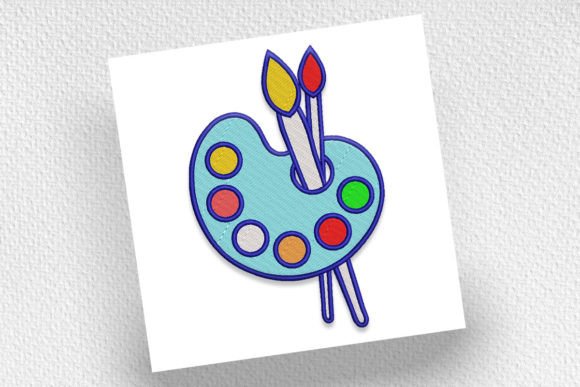
Palette and Brush: A Real-World Embroidery Designer’s Review
First Impressions: Playful, Precise, and Purpose-Built
When I opened Palette and Brush on Creative Fabrica, I wasn’t just scanning a thumbnail—I was mentally placing it on a linen apron for a local art teacher’s Back To School order. Visually, it’s cheerful without being childish: the palette shape is clean and recognizable, with subtle brushstroke accents and balanced negative space. It’s not overly dense or fussy—no tiny isolated elements that vanish at 3” wide. The design leans into satin stitch definition for outlines and soft fill stitch gradients in the “paint” wells, giving it dimension without aggressive texture. That tells me right away: this isn’t just a clipart-style embroidery file. It’s a considered machine embroidery design meant to hold up across fabric types and use cases.
Fits Naturally Into Real Projects—Not Just Mockups
I tested Palette and Brush across six real product categories: cotton tote bags, midweight sweatshirts, organic baby blankets, unbleached kitchen towels, structured cap fronts, and pillow covers made from textured linen-cotton blend. On every surface, it stitched cleanly—but its personality shifted meaningfully. On the tote bag? Bright and graphic—ideal for an art supply shop’s branded giveaway. On the baby blanket? Softened by gentle thread choices (matte cotton, no sheen), it read as sweet and intentional—not loud or overwhelming. And on the cap? With minor digitizing tweaks (tightening satin stitch angles, reducing underlay in curved zones), it held crisp definition even over the crown’s slight dome. That adaptability matters: Palette and Brush doesn’t force you into one aesthetic. It supports your brand voice, whether you’re selling handmade gifts on Etsy or supplying boutique merchandise.
Performance Notes You Can’t Skip
- Hoop size & detail retention: The full palette fits comfortably in a 4x4 hoop, but I recommend stitching it at 3.2–3.8” for most apparel. Smaller than 3” risks losing clarity in the inner brush details—especially on dark fabric where contrast drops.
- Stitch density & fabric pairing: Fill areas are moderate—not heavy enough to stiffen lightweight knits, but dense enough to prevent show-through on light-colored sweatshirts. For stretchy fabrics, a light cutaway stabilizer + basting spray kept puckering in check. On textured towels, I added a tear-away topper for smooth satin stitch flow.
- Thread colors & visual impact: This design shines when thread colors echo real paint—cobalt blue, cadmium yellow, alizarin crimson—not generic brights. On dark fabric, I swapped to high-contrast pastels (mint, lavender, buttercream) instead of white; they read cleaner and feel more cohesive.
- Wash durability: After three cold-machine washes (with mild detergent, air-dried), the satin edges remained sharp on cotton and linen. No fraying or loosening—critical for baby items or kitchen towels customers rely on daily.
How It Elevates Your Handmade Product—and Your Customer’s Experience
As a designer who ships 50+ custom embroidered pieces monthly, I notice how small details affect perceived value. Palette and Brush lands differently than generic “art” motifs because it reads *intentional*. Customers comment on the “thoughtful color placement” and “hand-drawn charm”—even though it’s machine-stitched. That translates directly to trust: when someone sees this on a personalized gift or nursery decor item, they don’t think “mass-produced.” They think “curated.” For Etsy sellers, that nuance boosts conversion and repeat orders. For craft fair vendors, it gives you a talking point: “Each palette is stitched with color-matched threads—we pick the hues to suit your fabric.” That level of care shows in product photography too: the balanced composition and clean lines make flat-lay shots pop without heavy editing.
Smart Workflow Tips Before You Stitch
- Always test Palette and Brush on scrap fabric matching your final product’s weight, weave, and stretch—even if it’s the same fabric type. A 100% cotton tee behaves differently than a 100% cotton tote.
- Review the embroidery file’s actual stitch count and layer order before hooping. Some versions include optional brushstroke accents—great for patches, less ideal for delicate baby blankets.
- Compare light and dark fabric mockups side-by-side. What reads as vibrant on white may look muddy on navy unless you adjust thread saturation or add a white underlay.
- Confirm licensing terms on the Creative Fabrica product page before selling finished items. Commercial embroidery rights vary by seller—don’t assume unlimited use.
- For caps or curved surfaces: slow down your machine speed by 20%, increase upper tension slightly, and verify needle type (size 75/11 sharp works best here).
Where It Shines—and Where to Pause
Palette and Brush excels in applications where charm, clarity, and color storytelling matter: custom apparel for teachers and creatives, embroidered patches for art camps, nursery decor bundles, and Back To School tote sets. It adds instant personality to otherwise neutral items—think plain canvas aprons or solid-color pillow covers—without overwhelming them. It also works beautifully as a printable mockup element for digital product sellers building design assets or social media kits.
That said, avoid using it at sub-2.5” scale on highly textured or napped fabrics (like fleece or terry cloth)—fine details blur. And while it’s not an applique design, don’t try to convert it into one without re-digitizing; the layered fills aren’t built for fabric placement.
Final Thought: A Reliable, Expressive Tool
Palette and Brush won’t replace your core logo files—but it might become your go-to for seasonal collections, limited-edition bundles, or client projects asking for “something artistic but not cliché.” It’s proof that a well-built Creative Fabrica embroidery design can do more than decorate: it can communicate tone, support storytelling, and quietly raise the bar on what customers expect from a handmade product. If you’re selecting embroidery files for real-world use—not just inspiration boards—this one earns its place in your working library.